We had few interesting presentations in class which touched upon Business Process Management. I found an interesting tool that allows individuals to create integrations and workflows where various system elements are combined to support well-defined processes.
Basics:
ActiveVOS is a Visual Orchestration System which uses BPEL 2.0 as the bedrock execution platform for the Visual Orchestration System, and includes support BPELforPeople and WS-Human Task for integrating humans into automated business processes. Orchestration tools allow individuals to create integrations and workflows where various system elements can be combined to support well-defined processes.
Target Users:
Development teams -- business analysts, developers and enterprise architects -- folks who need a Business Process Management Systems (BPMS) that delivers process applications quickly, easily and affordably.
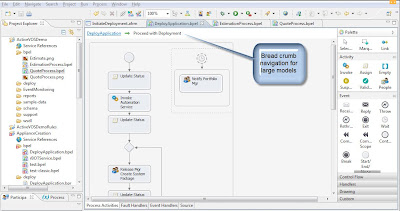
Sample working screen:
Real world example:
Case study - Synovus Financial Corp
Synovus Financial Corp. is a diversified financial services holding company with more than $30 billion in assets, based in Columbus, Georgia. Synovus provides integrated financial services including banking, financial management, insurance, mortgage, and leasing through 35 banks, 440 ATMs and other Synovus offices in Georgia, Alabama, Florida, South Carolina and Tennessee. Long-term financial growth has placed Synovus in the top level of the high performers in the financial services industry for three decades. Synovus has grown from a $147 million one-bank holding company in 1972 to today's $30 billion diversified multi-state financial servicesprovider.
With such rapid and expansive growth, Synovus faced many integration challenges. The company is now using the leading visual orchestration system, ActiveVOS™, to integrate and manage multiple mission-critical applications as part of its servicesoriented architecture (SOA) implementation. The benefits so far? Reduced
integration costs through the reuse of architecture and services, a scalable platform, faster time to market and a higher degree of customer satisfaction.
FULL document : http://www.activevos.com/doc/aug2008-synovus-casestudy.pdf
References:

